Canestrini Clark
A general-practice firm with an engine of its own — automotive claims management — the part it had hidden.
Canestrini Clark is an established German law firm with four offices across Swabia — Augsburg, Donauwörth, Göppingen and Ulm — and seven lawyers. Inside a full-service practice runs a specialist engine: traffic and automotive claims management.
- What I saw
- Eight equal practice areas in a 2016 menu, and its most provable engine — claims management — buried.
- What I changed
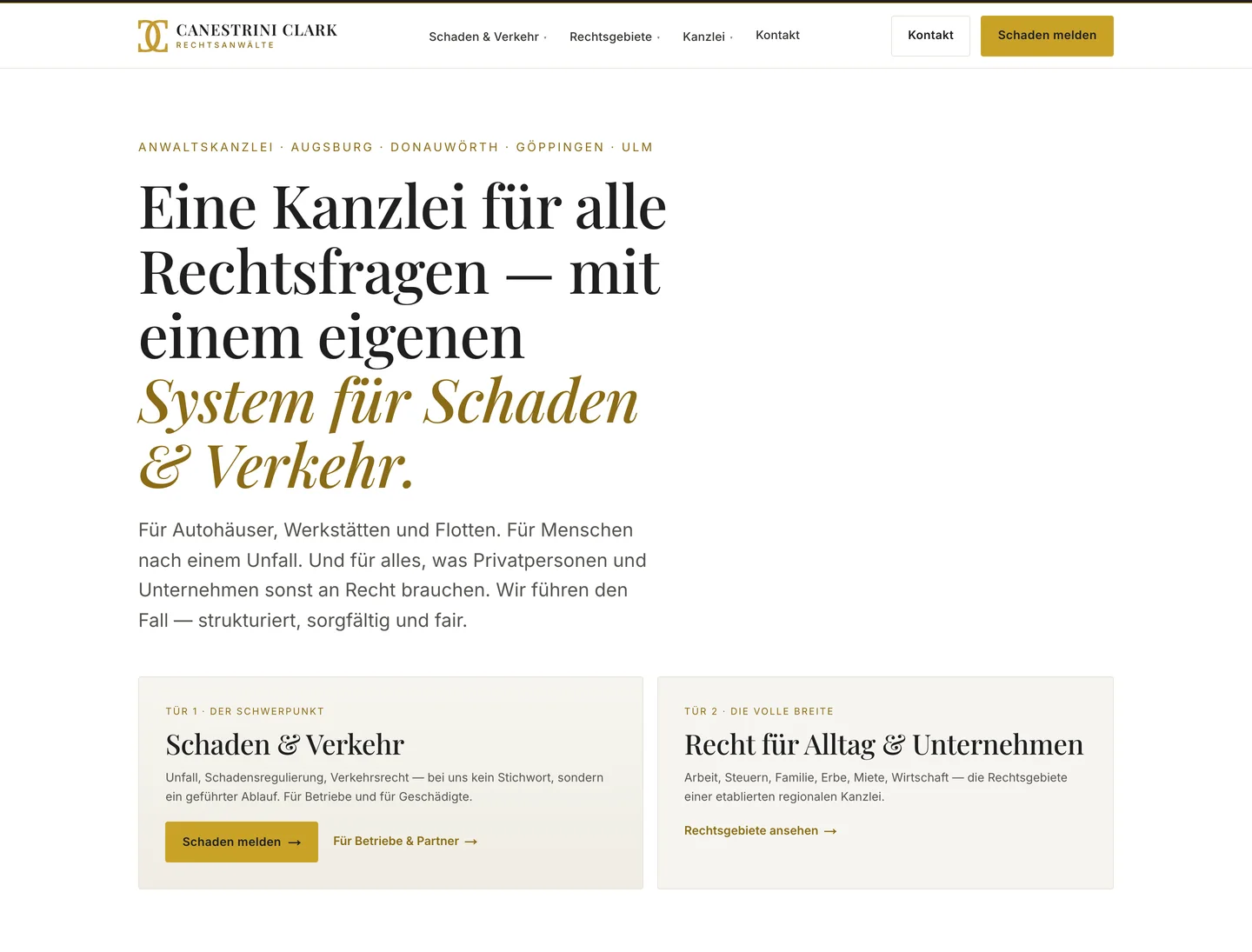
- From menu to spine: two doors — Damage & Traffic; Law for everyday life and business — and the claim shown as a six-step process.
Read the full case
What I noticed
The front door was a flat menu of eight equal practice areas on a 2016 template, while its sharpest, most provable substance sat buried: two specialist traffic lawyers (Fachanwälte für Verkehrsrecht) and a whole claims-management apparatus with a name of its own.
Why it mattered
The generic presentation destroys the firm's scarcest asset: conferred trust. In legal services everyone asserts competence; almost nobody can show trust that a third party has granted them. The firm was selling a system and describing a service.
What changed
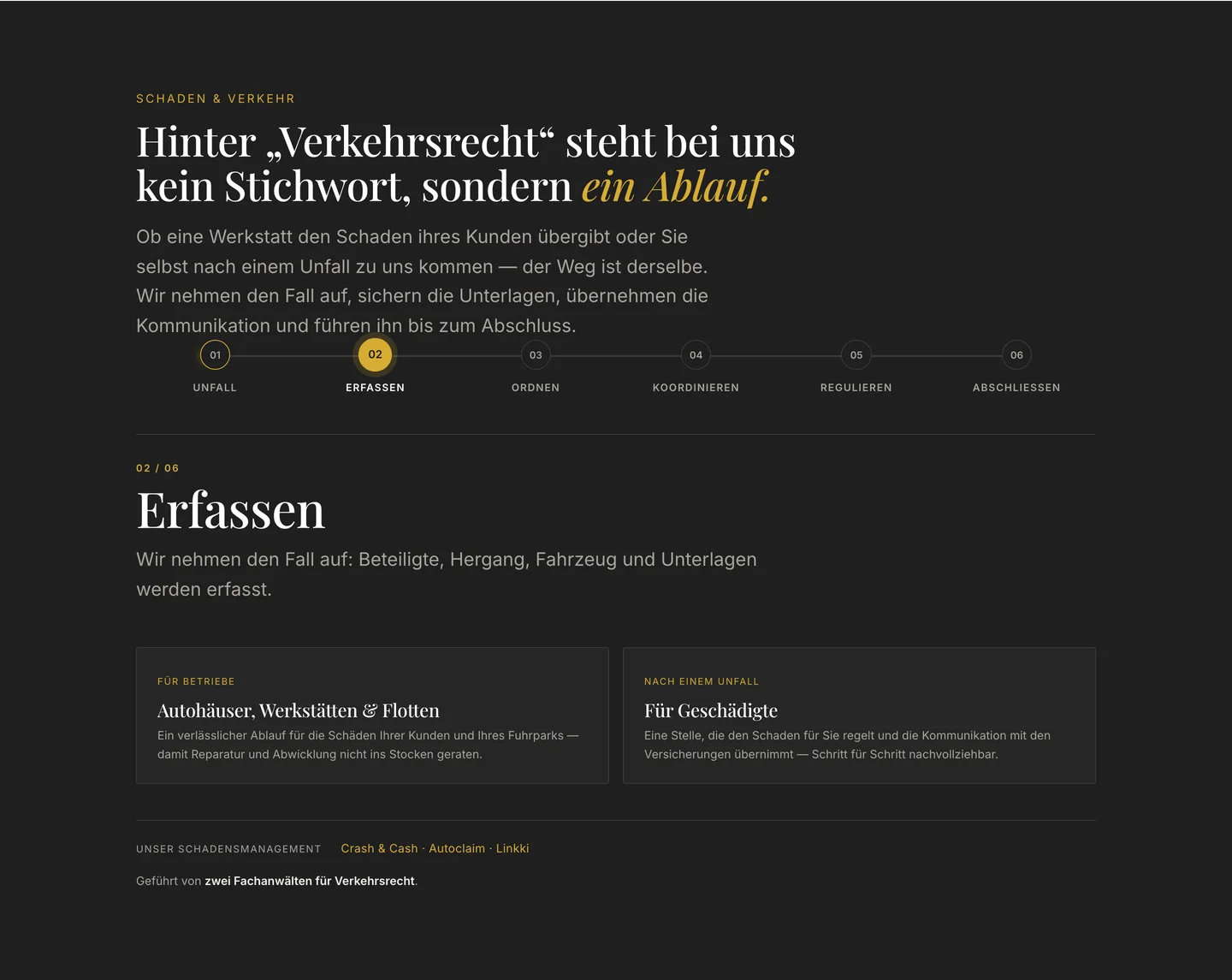
The site was reorganised «from menu to spine»: a two-door architecture — Door 1, Damage & Traffic; Door 2, Law for everyday life and business — and a signature moment that shows the claim as what it is, a process: Unfall → Erfassen → Ordnen → Koordinieren → Regulieren → Abschliessen. Trust is shown as evidence, not adjectives: verifiable credentials are kept distinct from what is, for now, the firm's own statement. Its identity was kept — gold, anthracite, Playfair — and it was deliberately built to resemble no other case.
What became possible
A truthful presentation of what the firm already is: a distinctive institution in a generic disguise, one operating system with two entrances. It's a frozen study, published with the firm's permission, and nothing has launched.
A firm that finally looks like what it does.
An independent design study, published with the firm's permission.