Club Ecuestre Arabian
Every riding club promises a passion for horses; not one tells you what it costs, when it runs, or whether there's room this week.
Club Ecuestre Arabian is a riding club in Pruvia de Arriba, a village of 56 people in Llanera, Asturias. Pablo Gil founded it in 2014. It had no website: its entire public existence was a Facebook page with no address and no opening hours, and an Instagram account named after the founder rather than the club.
We went through a wide sample of equestrian websites — the ones down the road, the ones with national reputations, and the ones the sector treats as best in the world — and they are astonishingly alike: the same four promises in the same order, welcome, all levels, a passion for horses, camps and birthdays. Different countries, different budgets, one voice.
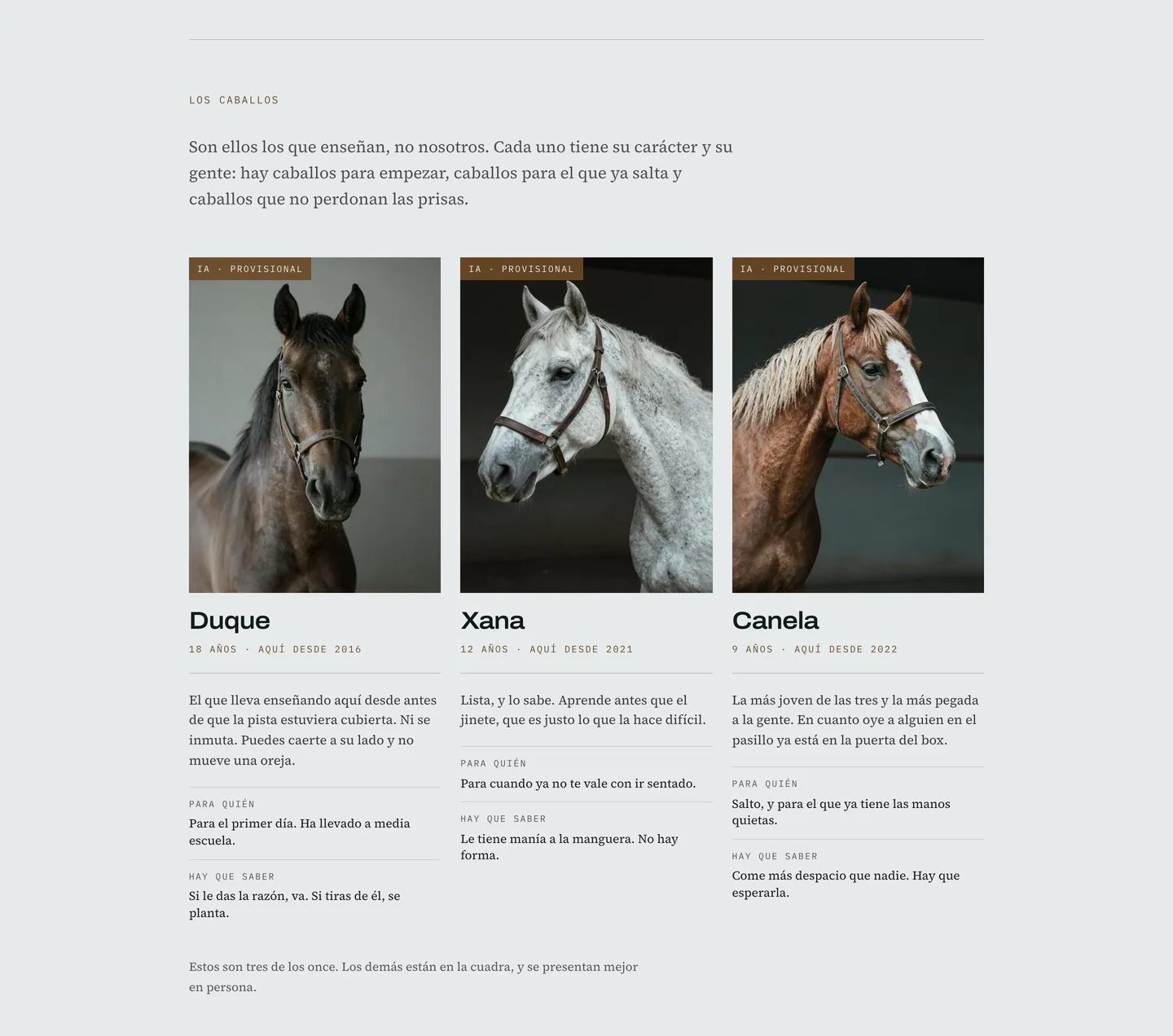
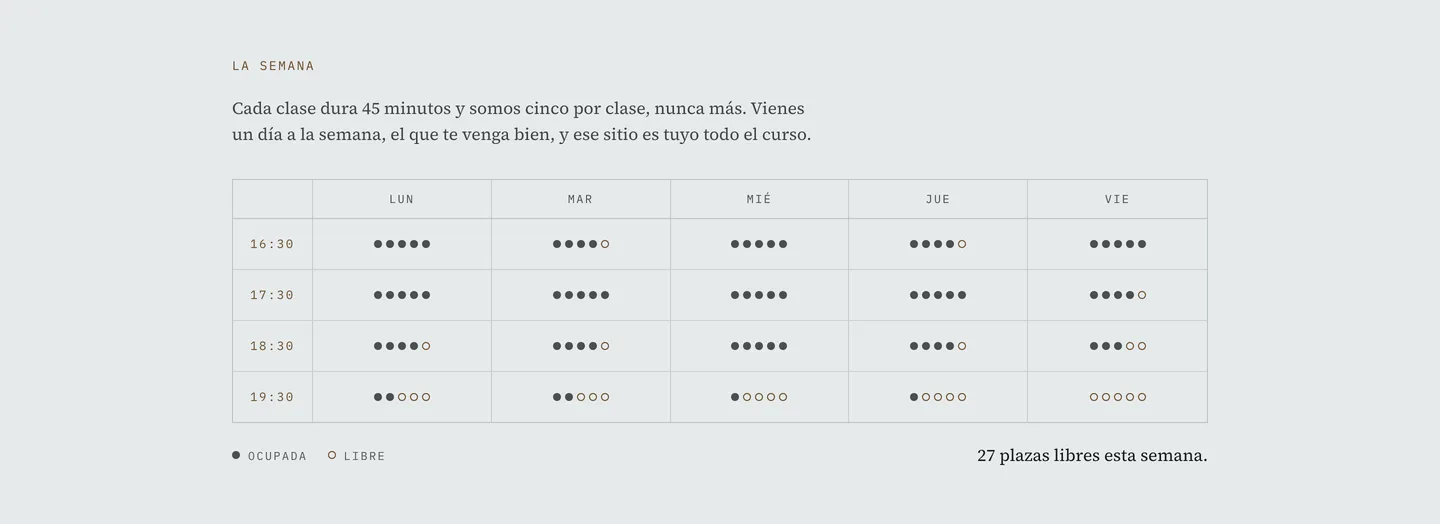
Four absences run through nearly all of them. Nobody publishes a price. Nobody publishes a timetable, or lets you see whether there is room. Nobody shows the horses — a riding school's actual product, the animal your daughter will sit on — beyond a mane in golden hour. And nobody shows the work: the category photographs the rosette and the jump, never the water, the hay, or six in the morning.
Then the thing specific to this club: two true descriptions that contradict each other. Customers describe somewhere small, familiar, affordable and good with children. The public record describes a yard that put six of its thirteen riders into the Asturian selection that became national endurance champion, and that runs the region's reference endurance race. Both are true. Neither was visible.
A family choosing a riding school is not buying a leisure activity. They are making a safety decision about their child, on top of a 500-kilo animal, on the basis of a website made of adjectives.
The category has trained itself to compete on warmth: everyone is welcoming, everyone is passionate, everyone loves horses. When every competitor says the same thing in the same words, the words stop carrying information and the decision falls back to proximity and word of mouth. There was a second reason here: the club's genuine distinction — an endurance record most riding schools in Spain cannot approach — was precisely what stayed invisible to the people choosing between this yard and the next one.
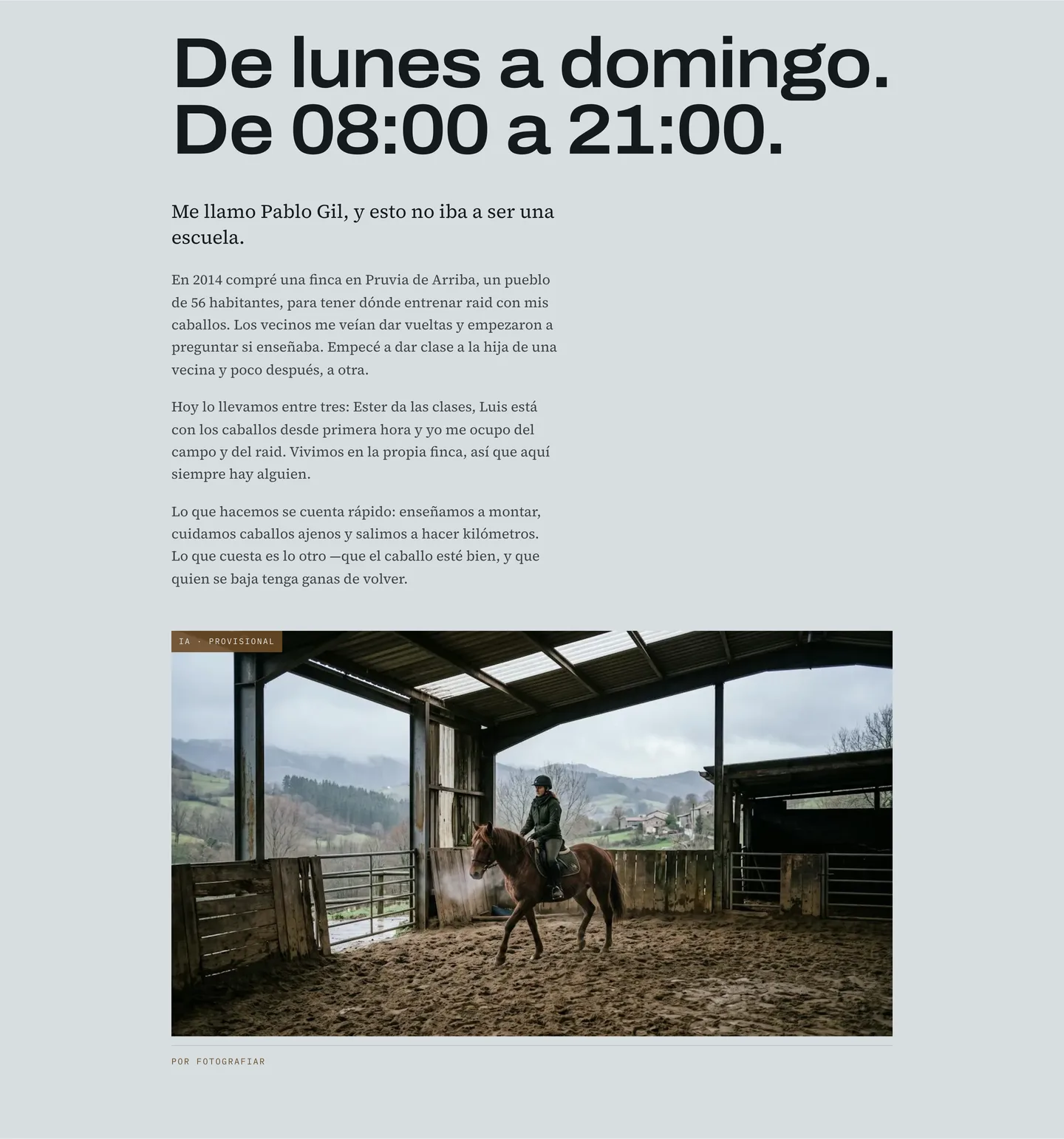
The concept is his own sentence. Asked what the place is, he describes his working day — so the page is a day: «De lunes a domingo. De 08:00 a 21:00.» The same structure doubles as the plan for the photography: every section carries an hour, and that hour is the light instruction for its picture.
The page opens by saying who is talking, and why he started: «Me llamo Pablo Gil, y esto no iba a ser una escuela» — my name is Pablo Gil, and this was never meant to be a school. He bought the farm to train endurance with his own horses; the neighbours watched him going round and asked whether he taught. It is the opposite of how every competitor opens, and it is the one thing none of them can copy.
Then the answers the category withholds: the timetable drawn as filled and open dots, readable in three seconds without a line of JavaScript; a profile for each school horse — what they are like, who they suit, and the thing you ought to know; and «how the first day goes», six steps from parking the car to leaving in it. A voice rule, written down and enforced: «yo» only for what he personally did, «nosotros» for the place and its offer — and he does not teach the school classes, Ester does; the page never pretends otherwise.
One section was removed rather than guessed at: the therapeutic riding, not for length, but because the only qualification standing behind it left with the person who held it.
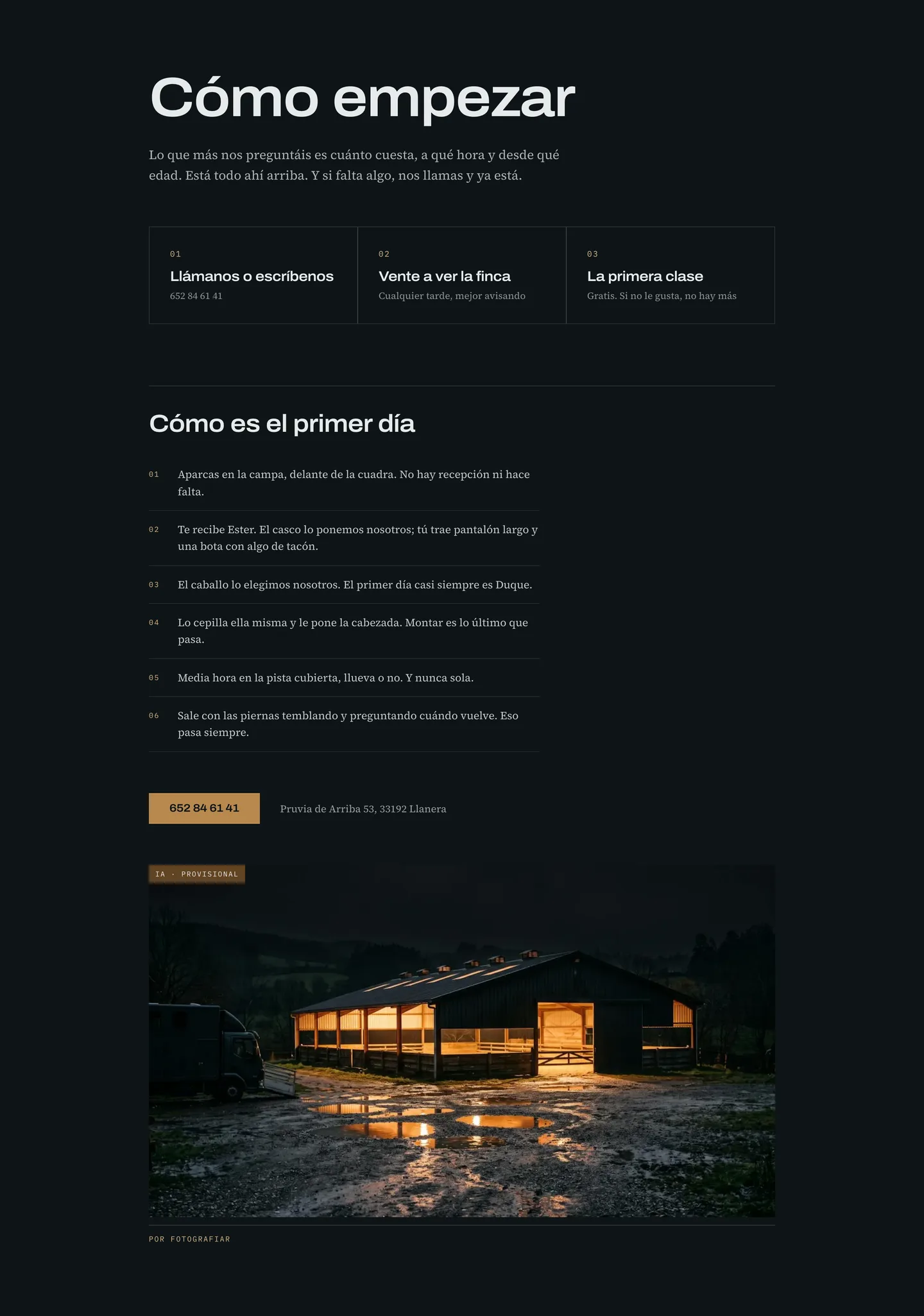
A family in Llanera could answer, before picking up the phone, what it costs, when classes run, whether there is room this week, who teaches, and which horse they would be on. No riding school within reach of that village offers any of it. And the club would stop competing on being welcoming — which it cannot win, because everyone claims it — and start competing on what it can actually prove.
It's a study: it exists as a private review build, unindexed and unlaunched. The photography is still to be made and is marked provisional on the page itself; the timetable, the places, the prices and the horses are concept, written so he can recognise his own yard and correct it — not the club's data. None of it is published as his until he confirms it.
A club that was already two good things, and showed neither.
An independent design study, published with the club's permission. The photography is provisional — marked as such on the page itself — and the operational content (timetable, places, prices and horses) is concept, not the club's real data.